
If you start to feel frazzled, testy, or run-down, you have overstepped a crucial line. Most people have some physical symptom that signals them that they are starting to run down their batteries. A sore throat, headache, or hemorrhoid flare-up is the universe's way of alerting you that you are getting stressed. Instead of working harder or overriding the symptom with a drug, step back and regroup. Replenish your spirit and then you are good to go.
If you have to do things that keep you busy, you can remain joyful as you go. Remember to value energy before stuff and connection before manipulation. When you do things in a hurry, you miss the party and undermine what you are trying to accomplish. Your appointment book is a navigational tool, not a vice you clamp around your head and squeeze. You can get everything on your to-do list checked off, but if your soul is gasping for air, your efforts have been for naught. Instead of writing down what you want to do, write down who you want to be and how you want to feel as you do it. What you seek is more spiritual than material. Keep spirit first and you will succeed spiritually and materially.
Using Busyness as a Way to Avoid Feeling
Many people use busyness as a way to avoid feeling. They do not want to face the issues of their lives, so they generate an endless stream of appointments, errands, and projects to avoid being with themselves. They say they do not have time to deal with their pain because they are too busy, but the very purpose of being so busy is to not deal with the pain. They are not running around; they are running away, which just drives the pain deeper. Blaise Pascal observed, "All of man's problems stem from his inability to sit in a room quietly by himself."
As a culture, we are very much in denial about our addiction to busyness. Denial stands for "Don't Even Notice I Am Lying." We have many 12-step and other support groups to deal with our cultural addictions to drinking, drugs, sex, gambling, and debt; yet we do not have many 12-step groups for workaholics or busyholics, which number far more in the population than any other single group of addicts.
Living at the End of Your Rope: Typical but Not Natural
 Living at the end of your rope may be typical, but I assure you it is not natural. Yet we accept busyholicism as normal, even respectable. If you were to show up at work drunk every day, you would soon be confronted and either fired or encouraged to get help. But when you work 12 hours a day, whittle your personal life back to a hangnail, and have to paste Post-Its on your hotel room TV screen to remind you what city you are in, no one questions that.

You scurry frantically across town, flooring the gas pedal at yellow lights, amped by intravenous Starbucks, driving with one hand, punching cell phone numbers with the other, and trying to keep the hot Styrofoam cup of triple espresso between your thighs from thwarting your future parenthood. You pride yourself on multitasking and feel like an underachiever if you're not spinning at least three plates at once, checking e-mail on line 1 while toggling between your boss on line 2 and your honey on the cell. Then someone knocks at the door and when you return you forgot who was on which line. But WAIT A MINUTE! (Huff, huff, puff, puff.) Does this really feel good? Is this really how you were born to live? If you did this for the rest of your life, how would you feel when you leave? Is it possible you could actually have a life?
I sat in on a magazine interview with Dr. Stephan Rechtschaffen, CEO of Omega Institute and author of Timeshifting. During the interview he suggested that we might be happier and more successful if we focus on one thing at a time. "But aren't you dangerously influencing people against multitasking?" the reporter asked. My God, I thought, we've come to a point where we have to defend being fully present!
Is Your Busyness Killing Your Heart?
The Chinese written character for the word "busy" is a combination of two other characters: "killing" and "heart." Heart disease, the foremost cause of death in our culture, is just what it says: the heart is not at ease. It is stressed. It is pressured. It is being asked to do more than it is designed to do. Yet heart disease, like all disease, can be prevented or reversed by returning to ease. And what is ease, but living in harmony with your intentions?
Each day set aside some time to do something to feed your soul. Treat yourself according to the style to which you'd like to become accustomed. Rassle with your pooch or curl up with your cat. Make smoldering love in the middle of the afternoon. Buy that new high-definition flat screen TV you've been eying. Dance naked to your favorite CD. Whatever you do, don't settle for a life without luster; then you become just another zit on the complexion of life. When your heart feels full, you will have so much more clarity and presence that you will easily handle the things that are problems now.
Reprinted with permission of the publisher,
Jodere Group, Inc. ©2002. www.joderegroup.com
Article Source
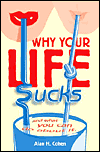 Why Your Llife Sucks: And What You Can Do About It
by Alan H. Cohen.
Info/Order this book (new edition)
About the Author

Alan H. Cohen is the author of 17 popular inspirational books, including the best selling The Dragon Doesn't Live here Anymore and the award winning A Deep Breath of Life. A frequent guest on television and radio, Alan is a faculty member at Omega Institute in New York, conducts life mastery seminars in Hawaii, and is an acclaimed keynote speaker at educational, health, and corporate institutions throughout the world. www.alancohen.com
Books on Improving Performance from Amazon's Best Sellers list
"Peak: Secrets from the New Science of Expertise"
by Anders Ericsson and Robert Pool
In this book, the authors draw on their research in the field of expertise to provide insights into how anyone can improve their performance in any area of life. The book offers practical strategies for developing skills and achieving mastery, with a focus on deliberate practice and feedback.
Click for more info or to order
"Atomic Habits: An Easy & Proven Way to Build Good Habits & Break Bad Ones"
by James Clear
This book offers practical strategies for building good habits and breaking bad ones, with a focus on small changes that can lead to big results. The book draws on scientific research and real-world examples to provide actionable advice for anyone looking to improve their habits and achieve success.
Click for more info or to order
"Mindset: The New Psychology of Success"
by Carol S. Dweck
In this book, Carol Dweck explores the concept of mindset and how it can impact our performance and success in life. The book offers insights into the difference between a fixed mindset and a growth mindset, and provides practical strategies for developing a growth mindset and achieving greater success.
Click for more info or to order
"The Power of Habit: Why We Do What We Do in Life and Business"
by Charles Duhigg
In this book, Charles Duhigg explores the science behind habit formation and how it can be used to improve our performance in all areas of life. The book offers practical strategies for developing good habits, breaking bad ones, and creating lasting change.
Click for more info or to order
"Smarter Faster Better: The Secrets of Being Productive in Life and Business"
by Charles Duhigg
In this book, Charles Duhigg explores the science of productivity and how it can be used to improve our performance in all areas of life. The book draws on real-world examples and research to provide practical advice for achieving greater productivity and success.